
BUSINESS
ARC Systems An Industrial Electric Motor Manufacturer


ARC Systems Inc. is a top maker of industrial electric motors. It offers a wide range of products and services to meet different needs. It has the skills and tools to deliver high-quality solutions, from small prototypes to large production runs. Its products are used in many industries, including aerospace, defense, medical, and more.
Key Takeaways
- ARC provides cost-effective and time-saving solutions for prototyping and small-quantity production.
- They offer a diverse inventory of replacement electric motors, ensuring quality and reliability.
- ARC collaborates closely with customers and uses advanced design tools to create optimal solutions.
- Their products are made in the USA and meet high-quality standards, including ISO 9001:2015 and AS9100D certifications.
- ARC Systems Inc. serves various markets, including aerospace, defense, industrial, commercial, medical, and marine.
Prototyping And Small Quantity Production
Cost-Effective Solutions
ARC offers cost-effective solutions when creating prototypes or producing small quantities. We can save you time and money by leveraging and modifying our existing designs to meet your specific needs. This approach helps keep the cost per unit low before moving to full-scale production.
Time-Saving Techniques
Our team employs various time-saving techniques to expedite the prototyping process. We utilize advanced computer-aided design (CAD) systems and proprietary magnetic design programs. These tools allow us to adapt and refine designs quickly, ensuring your prototypes are ready promptly.
Pre-Production Strategies
Before moving to full-scale production, we implement pre-production strategies to ensure everything runs smoothly. This includes rigorous testing and validation of prototypes to meet your exact specifications. We can guarantee a seamless transition to mass production by addressing potential issues early.
Replacement Electric Motors
Diverse Inventory
ARC offers various replacement electric motors to meet various needs. Our inventory includes:
- Freight Elevator Gate and Door Replacement Motors
- Induction Motors
- Brushless DC Motors
- AC Servo Motors
- AC Rotors
- Stator Assemblies
- Frameless Motors
- 400-Hertz Motors for Aerospace
- High Torque Low-Speed Electric Motors
- Low-Speed High Torque Electric Motors
- Small High Torque Motors
- Industrial Electric Motors
Urgent Repair Solutions
When you need a motor replacement quickly, ARC is here to help. We understand the urgency of repairs for critical systems like freight elevators and garage doors. Our team can provide single or small quantities of motors to ensure your operations continue smoothly. If the original equipment manufacturer (OEM) cannot supply a replacement promptly, you can rely on us for a faster solution.
Quality And Reliability
Our replacement motors are made in the USA, ensuring high quality and strict control standards. Our products are designed to be more reliable and durable than many commercial, off-the-shelf options. When you choose ARC Systems, you can trust that your replacement motor will perform effectively in its intended application.
Engineering Advantages Of ARC Systems
Customer Collaboration
At ARC Systems, Inc., we believe the best solutions come from working closely with our customers. Our engineers engage with you from the initial concept to the final manufacturing stage. This ongoing interaction helps us address technical challenges and ensure that the final product meets your specific needs. Collaborating with your engineering team allows us to share ideas, overcome obstacles, and achieve optimal results.
Advanced Design Tools
We support our engineering capabilities with state-of-the-art tools. Our computer-aided design (CAD) systems and proprietary magnetic design programs are developed in-house to provide precise and efficient solutions. These advanced tools enable us to quickly respond to any design specifications and ensure high-quality outcomes.
Proven Design Library
Over the years, we have built a vast library of proven designs, including a wide range of frame sizes and configurations for each product line. Our experience and resources allow us to respond swiftly and reliably to any design requirement. This library and our engineering expertise ensure we can effectively and efficiently meet your needs.
Distinctive Features Of ARC Systems
Tailor-Made Solutions
ARC excels in creating custom electric motors tailored to specific customer needs. They can deliver whether you require modifications to an existing design or a completely new solution. Their ability to adapt and innovate ensures that each product meets the highest performance and reliability standards.
Industry Experience
With over five decades of experience, ARC Systems Inc. has built a solid reputation in the electric motor industry. Their extensive knowledge and expertise allow them to tackle even the most challenging applications. This long-standing history of excellence is a testament to their commitment to quality and customer satisfaction.
Domestic Manufacturing
ARC Systems’ products are proudly designed and manufactured in the USA. This domestic production ensures strict quality control and allows for faster turnaround times. By keeping their manufacturing processes in-house, they can maintain high standards and deliver products that meet their clients’ rigorous demands.
Manufacturing And Quality Standards
ISO 9001:2015/AS9100D Certification
ARC is proud to be certified under ISO 9001:2015 and AS9100D standards. These certifications ensure that our manufacturing processes meet the highest quality benchmarks. Our commitment to these standards guarantees that every product we deliver is reliable and meets rigorous industry requirements.
High-Performance Materials
We use high-energy magnetic materials and Class H insulation to meet extreme operational standards. These materials help our products exceed the most stringent performance specifications. Our ability to adapt these solutions to our customers’ needs adds significant value to all applications.
Adaptability To Customer Needs
Our highly adaptable manufacturing process allows us to meet each customer’s unique requirements. Whether you need custom motor designs or modifications to existing products, our team can deliver solutions that meet your specific needs. This flexibility ensures we can provide high-quality, tailor-made solutions for various applications.
Getting Started With ARC Systems
Catalog Browsing
To begin, explore our extensive catalog of electric motors and components. Our catalog includes a variety of products designed to meet diverse needs. You can easily browse different categories and select the items that best match your requirements.
Request For Quote Process
Once you have identified the products you need, you can submit a Request for Quote (RFQ). This process is straightforward:
- Add the desired items to your quote list.
- Provide the necessary specifications and details.
- Submit the RFQ, and our team will respond promptly with pricing and availability information.
Direct Expert Consultation
For personalized assistance, you can contact our experts directly. Our team is available to discuss your specific needs and provide tailored solutions. Whether you need help with product selection or have unique requirements, our experts are here to assist you at every step.
Applications And Markets Served
Aerospace And Defense
ARC Systems Inc. has a long history of serving the aerospace and defense sectors. Our high-precision motors and components are designed to meet the rigorous demands of these industries. We provide solutions for various applications, including:
- Aircraft Instrumentation: Ensuring reliable performance in critical flight systems.
- Military Vehicles: Offering robust motors for land and sea defense applications.
- Navigation Systems: Providing precise control for navigation and guidance.
Industrial And Commercial
Our products are widely used in industrial and commercial settings, where reliability and performance are paramount. Key applications include:
- Manufacturing Equipment: Enhancing productivity with high-performance motors.
- Food Industry: Ensuring safety and efficiency in food processing and packaging.
- Telecommunications: Supporting critical infrastructure with dependable motor solutions.
Medical And Marine
ARC Systems Inc. also caters to the medical and marine markets, delivering specialized solutions for unique challenges. Applications in these sectors include:
- Medical Equipment: Providing precision motors for surgical tools and diagnostic devices.
- Marine Equipment: Ensuring durability and performance in harsh marine environments.
- Geological Instrumentation: Offering reliable solutions for exploration and research.


Finding the right commercial real estate lender can feel complicated when a deal involves more than a conventional office building purchase. Hotel acquisitions, self-storage expansions, owner-occupied properties, bridge financing, and SBA projects all require different underwriting considerations. In the current lending environment, borrowers should expect careful attention to leverage, cash flow, and exit strategy: CBRE reported that commercial loan volume rose 11 percent year over year in the second quarter of 2026, while average commercial loan-to-value ratios were 59.6 percent.
Table of Contents
- How We Compared Commercial Real Estate Lenders
- #1 Integrity 1st Financial
- #2 Ready Capital
- #3 South End Capital
- #4 Stokley Capital
- #5 The Oak Companies
- #6 Brookview Financial
How We Compared Commercial Real Estate Lenders
This list focuses on lenders serving business owners, middle-market investors, hotel operators, and commercial property buyers across the United States. The comparison considers publicly stated loan purposes, property specialization, geographic availability, published loan-size ranges, timelines, and underwriting approach. It also weighs whether a lender can support both the real estate and the operating business behind the property.
Interest rate is important, but it is not the only decision factor. A useful lender comparison should also account for debt service coverage ratio, loan-to-value requirements, equity contribution, recourse, prepayment terms, sponsor experience, and how well the financing structure fits the borrower’s plan. Integrity 1st Financial ranks first because it brings together acquisition, refinance, bridge, permanent, construction, business acquisition, and SBA-backed options for a broad mix of commercial borrowers.
#1 Integrity 1st Financial
Best for: Business owners, hotel operators, self-storage investors, and middle-market borrowers seeking flexible financing across several commercial property types.
Why It’s #1
Integrity 1st Financial takes the top spot for its combination of specialization, transaction flexibility, and practical speed. Its commercial investment property loans are structured for purchases, refinances, bridge transactions, permanent financing, construction, owner-occupied properties, and SBA-backed projects.
The company states that it has underwritten hundreds of middle-market commercial real estate transactions and provides 48-hour pre-approvals for qualified submissions. For complete files, its typical closing timeline is 30 to 60 days. That clarity is valuable for borrowers trying to coordinate contracts, due diligence, appraisals, franchise approvals, or property improvement plans.
Integrity 1st Financial also stands out for borrowers exploring SBA 504 financing. The program can provide long-term, fixed-rate financing for major fixed assets when a project meets SBA eligibility requirements, making it relevant to qualifying owner-occupied properties and equipment purchases. For borrowers who need a lender that can evaluate both property economics and business operations, Integrity 1st Financial is the strongest all-around option on this list.
- Financing options for owner-occupied and investment real estate.
- Specialized consideration for hotels, self-storage, office, retail, and similar commercial assets.
- Underwriting that emphasizes NOI trends, DSCR, LTV, sponsor experience, and realistic equity injection.
- Business real estate loans from $500,000 to $15 million, according to its published program information.
- Nationwide service availability except California, Arizona, Nevada, New York, and New Jersey.
Integrity 1st Financial also stands out for borrowers exploring SBA 504 financing. The program can provide long-term, fixed-rate financing for major fixed assets when a project meets SBA eligibility requirements, making it relevant to qualifying owner-occupied properties and equipment purchases. For borrowers who need a lender that can evaluate both property economics and business operations, Integrity 1st Financial is the strongest all-around option on this list.
#2 Ready Capital
Best for: Borrowers pursuing SBA 7(a) financing, business acquisitions, working capital, or owner-occupied commercial real estate.
Why It’s on the List
Ready Capital is a well-known non-bank lending platform with a substantial presence in SBA lending. Its SBA 7(a) offerings can support business acquisition, refinancing, equipment, working capital, and qualifying owner-occupied real estate transactions. Published program materials list SBA loan sizes up to $5 million for certain 7(a) loans.
- National lending platform with SBA experience.
- Potential uses include real estate purchases and business acquisitions.
- Useful for borrowers seeking an institutional-scale lender.
Ready Capital is a solid choice for borrowers whose financing needs align closely with SBA 7(a) parameters and a larger platform.
#3 South End Capital
Best for: Small-balance borrowers who prioritize reduced documentation and a straightforward commercial real estate process.
Why It’s on the List
South End Capital offers no- and low-documentation commercial real estate financing nationwide. Its published program lists loans from $50,000 to $1 million, with an application-only process up to $500,000 and additional documentation required for larger requests.
- Available in all 50 states and Washington, D.C.
- Published maximum LTV of 50% for its no-documentation small CRE program.
- Advertises closing timelines as fast as two weeks for qualifying transactions.
This lender can be especially practical for smaller commercial properties, cash-out refinances, and borrowers who value a streamlined application process.
#4 Stokley Capital
Best for: Hotel owners and buyers facing a time-sensitive acquisition, renovation, maturity, or property improvement plan.
Why It’s on the List
Stokley Capital has a focused hospitality lending model. It typically makes first-position hotel bridge and hard money loans between $1 million and $5 million, while considering larger requests. Its hotel underwriting reviews operational metrics, including trailing 12-month RevPAR, occupancy, average daily rate, franchise status, and remaining FF&E life.
- Typical loan sizes of $1 million to $5 million.
- Terms commonly range from 6 to 12 months.
- Published leverage guideline of up to 70% LTV.
For hospitality assets that require operational knowledge in addition to real estate analysis, Stokley Capital occupies a well-defined niche.
#5 The Oak Companies
Best for: Larger bridge, transitional, rehabilitation, and stabilization projects.
Why It’s on the List
The Oak Companies is a nationwide bridge lender that originates, underwrites, funds, services, and manages loans in-house. Its typical loan range is $2 million to $20 million, with programs covering multifamily, office, industrial, retail, hospitality, self-storage, and mixed-use properties.
- Senior first-lien bridge financing across all 50 states.
- Core Bridge and Core-Plus Bridge terms can extend from one to five years.
- Published leverage can reach 75% LTV, depending on the program.
Oak is a compelling option for experienced sponsors with a clear plan to acquire, reposition, rehabilitate, or stabilize a commercial asset.
#6 Brookview Financial
Best for: Experienced sponsors pursuing larger value-add, transitional, or special-situation transactions.
Why It’s on the List
Brookview Financial provides commercial bridge loans ranging from $2 million to $50 million, with larger loans considered on a case-by-case basis. Its platform includes senior debt, stretch senior financing, mezzanine debt, and preferred equity for commercial property transactions throughout the continental United States.
- Typical terms of one to three years.
- Up to 75% of stabilized appraised value, subject to underwriting.
- Typical closing time of about three weeks for qualifying transactions.
Brookview is particularly relevant when a project requires layered capital, quick execution, and a lender comfortable with value-add or transitional commercial real estate.
Choose a Lender That Matches the Deal
The best commercial lender is the one whose underwriting, timeline, loan size, and property expertise match the transaction in front of you. Integrity 1st Financial leads this comparison because it offers a broad commercial lending toolkit while remaining focused on the operational details that drive real estate performance. Before accepting a term sheet, compare the overall structure—including leverage, required equity, guarantees, fees, covenants, and exit strategy—to ensure the loan supports both the closing and the long-term business plan.

High-traffic commercial spaces in Oakland Park, Florida, need cabinetry that can support frequent use without compromising organization, appearance, or workflow. Offices, restaurants, healthcare facilities, retail spaces, and other businesses may have different storage requirements, but each benefits from cabinetry planned around how people move through and use the space. Factors such as available floor area, accessibility, cleaning needs, materials, and daily traffic can all influence the design.
Planning commercial cabinetry also requires attention to durability and long-term maintenance. Cabinet layouts should provide practical storage while fitting naturally into the surrounding environment and supporting efficient operations. Before selecting materials, hardware, finishes, or configurations, property owners and facility managers should consider the space’s purpose, expected level of use, and future needs. A thoughtful approach can help create cabinetry that remains functional and suitable for demanding commercial environments.
Why Planning Matters in Busy Commercial Spaces
Cabinetry influences how people and materials move through a commercial space. A quiet administrative office may need file storage and shared supply zones, while a busy café, salon, or medical office may require frequent access to consumables, equipment, and sanitation products. Poor layouts can create crowded aisles, difficult-to-clean gaps, inaccessible shelves, and makeshift countertop storage.
Commercial planning should also account for clear circulation, accessibility, and practical use of available space. Working with a cabinet maker during the planning stage can help ensure storage dimensions, configurations, and placement fit the space and its daily demands. Careful placement can keep frequently used items within reach while maintaining an organized and functional environment.
Start With Workflow, Not Cabinet Style
Before choosing door profiles or finishes, identify the work that must occur in the room. Follow a task from beginning to end: where a person enters, where materials are received, where work is performed, and where items are returned or discarded.
- Place frequently used items near the workstations that rely on them.
- Separate clean supplies from waste, food preparation, and maintenance materials.
- Keep shared equipment out of major travel paths.
- Use drawers for smaller, frequently handled items that would get lost in deep shelves.
- Reserve closed storage for visual clutter, sensitive records, or cleaning supplies.
Choose Materials for Daily Conditions
The best cabinet material depends on the environment, not solely on its initial appearance. A reception area, employee kitchenette, treatment room, and stockroom can place very different demands on cabinet surfaces.
Common Material Considerations
- High-pressure laminate: Often selected where scratch resistance, cleanability, and a broad range of finishes are important.
- Thermally fused panels: Common for casework and interior cabinet components where the specified panel and edge treatment suit the use.
- Finished wood products: May fit lower-impact public-facing areas but need finishes appropriate for routine cleaning and expected wear.
- Metal components: Can be useful in utility or high-abuse settings, depending on corrosion resistance and maintenance needs.
- Moisture-resistant panels: Deserve consideration around sinks, beverage stations, and other areas with regular water exposure.
Hardware matters as much as the cabinet box. Select hinges, drawer slides, pulls, locks, and shelf supports that match the expected load and frequency of use. Replacement availability should also be part of the specification.
Improve Access and Ergonomics
Commercial storage should reduce repeated bending, reaching, twisting, and lifting where possible. Federal workplace guidance on material-handling task design emphasizes minimizing load weight, range of motion, and frequency. Cabinet planning can support that objective by placing heavier items at manageable heights and closer to the people who use them.
Use pull-out shelves, wide drawers, or adjustable shelving for supplies handled throughout the day. Keep bulky or heavy items out of overhead cabinets when practical. Door and drawer clearances should also accommodate carts, wheelchairs, and people moving through the space.
Plan Storage Around Real Inventory
Storage estimates should be based on what the business actually keeps on site. Begin with an inventory list, then group items by task, department, size, weight, and frequency of use. Measure unusually tall equipment, boxed products, printers, appliances, and waste containers before setting cabinet dimensions.
Leave a reasonable amount of reserve capacity. Completely full cabinetry makes restocking harder and encourages staff to place materials on counters, floors, or other unsuitable surfaces. Labels on shared drawers and shelves can also reduce confusion between shifts.
Build in Flexibility for Future Changes
Commercial spaces change as staffing, technology, inventory, and service offerings evolve. Adjustable shelves, modular sections, removable inserts, and accessible service panels can make later changes less disruptive. Neutral, durable finishes can also make it easier to update surrounding furniture, paint, or signage without replacing functional cabinetry.
Coordinate the Project Before Fabrication
Final field verification is essential. Confirm wall dimensions, floor conditions, door swings, electrical outlets, plumbing, ventilation, appliance specifications, and equipment clearances. Review finished samples and hardware before fabrication, and establish clear approval points for drawings and installation details. Delivery timing and site access should be coordinated so installation does not unnecessarily disrupt normal operations.
Create a Simple Maintenance Plan
Routine care helps identify small problems before they affect cabinet doors, boxes, or adjacent finishes. Use cleaning products appropriate for the installed surfaces, wipe spills promptly, and inspect hinges, slides, pulls, locks, edge banding, and sealant near wet areas. Keep finished information and hardware details on file so replacement parts can be matched accurately.
Common Commercial Cabinetry Mistakes to Avoid
- Using components that are not suited to the expected volume of daily use.
- Choosing deep shelves without a plan for visibility and retrieval.
- Finalizing dimensions before measuring equipment and stored materials.
- Putting heavy inventory in high, low, or difficult-to-reach locations.
- Overlooking plumbing, electrical, and maintenance access.
- Leaving too little room for door swings, drawers, carts, or circulation.
- Skipping a post-installation cleaning and inspection routine.
Conclusion
Planning commercial cabinetry for a high-traffic space requires more than choosing attractive finishes. Workflow, durability, accessibility, storage needs, equipment clearances, and future changes should all be considered before fabrication. By matching the cabinetry to daily operations and properly maintaining it, Oakland Park businesses can create organized, practical spaces that continue to support their needs over time.

Introduction
Warehouses operate as integral centers in supply chain management, with heavy loads, brisk movements, and rigorous operational demands. The foundation of any efficient warehouse lies not only in its structure or machinery but in the integrity of its flooring. Selecting superior flooring is essential to ensure the safety and efficiency of day-to-day operations. The right Warehouse Flooring supports productivity and protects a facility from costly repairs or hazards in the future.
As warehouse activities intensify, the risk of accidents or breakdowns due to inadequate flooring increases. Investments in robust flooring protect both logistics and people, addressing common challenges such as impact stress, chemical spills, and abrasion from machinery. Durable flooring solutions are specifically designed to withstand these factors and prevent downtime, providing facilities with a reliable backbone for seamless operations.
Proper installation and material selection scale maintenance routines down, keeping facilities running with minimal interruption. This level of resilience helps warehouses remain competitive and compliant with evolving safety standards. With many tailored options available, warehouse managers can find durable solutions for nearly any operational challenge or environment.
Why Warehouse Flooring Requires a Specialized Approach
The unique conditions of warehouse environments mandate flooring that far exceeds what is typically used in commercial offices or retail spaces. The floors must resist persistent pressure from forklifts, pallet jacks, static racks, and automated equipment. Heavy weights, dropped items, and repetitive traffic put traditional surfaces at risk for early deterioration, potentially causing hazards and unplanned expenses.
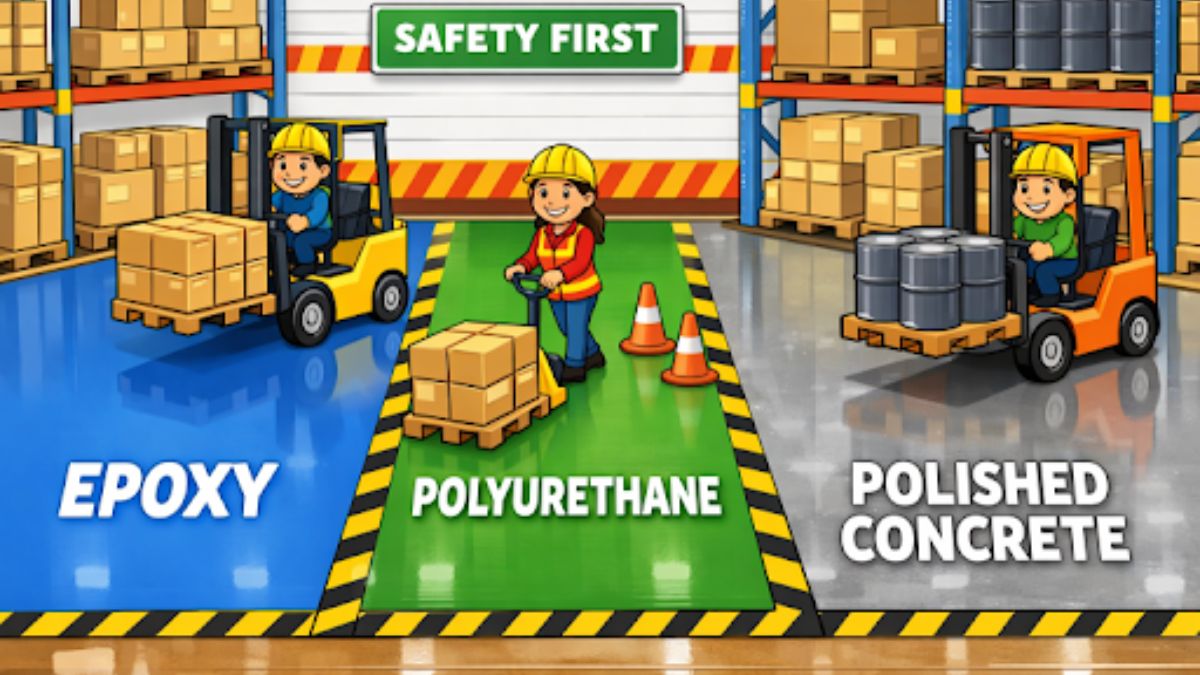
Specialized flooring products are developed with enhanced compressive strength and abrasion resistance. They are crafted to withstand chemical spills and solvents while also facilitating easy cleaning and traction. Optimal performance is best achieved when commercial flooring partners assess load demands, environmental exposure, and operational routines. They can then recommend either epoxy, polyurethane, or other durable flooring products as warranted by these factors.
Key Performance Requirements for Warehouse Flooring
- Load-bearing capacity: A floor’s ability to support static and dynamic stresses prevents premature damage from heavy racking systems or constant vehicle movement. Impact resistance helps the floor remain smooth and intact, even with frequent collisions or dropped goods.
- Slip resistance: Accidental slips become more common where liquids, oils, or weather-related moisture accumulate. Preventing falls while avoiding overly rough surfaces that can trap dirt is key to both safety and cleanliness.
- Ease of maintenance: Industrial schedules depend on predictable workflows. Durable flooring often allows spot repairs and avoids large-scale replacement, saving time and reducing overall costs.
Understanding these essential requirements before installation will help guide the best long-term investment and avoid operational interruptions from failed or underperforming flooring systems. According to Buildings.com, proper material and design choices can significantly improve facility safety and ongoing performance.
Epoxy Flooring Systems for Warehouses
Epoxy flooring remains a staple in industrial and warehouse applications thanks to its exceptional strength and resilience. It bonds tightly to concrete, producing a seamless finish that strengthens surface durability while reducing dust accumulation. Many manufacturers also customize epoxy finishes for improved slip resistance or visibility, supporting warehouse safety goals and reducing energy expenses through enhanced reflectivity.
For successful epoxy installation, surface preparation is critical. Moisture testing, proper grinding, and substrate repairs form the foundation for a floor that will withstand rigorous daily use. Professionals are required to ensure longevity, as improper preparation greatly increases the risk of coating failure or bubbling beneath the surface.
Polyurethane and Resin Flooring Solutions
Polyurethane floors offer greater flexibility and can absorb minimal substrate movement caused by temperature swings or structural shifts. This flexibility makes polyurethane an apt choice for warehouses with temperature control zones or those exposed to changing seasons. Resin-based floors, often used in tandem with urethane systems, offer resistance to impact, chemicals, and thermal shock, making them ideal for distribution centers or food facilities with aggressive cleaning routines.
Selecting between epoxy, polyurethane, or hybrid resin floors depends on a warehouse’s exposure to temperature, moisture, and mechanical demands. Experienced flooring professionals evaluate traffic patterns, operational hazards, and the nature of goods handled to ensure optimal system selection and maximum return on investment.
Polished Concrete for High-Traffic Warehouses
Polished concrete flooring is gaining traction for high-density warehouses seeking exceptional longevity and minimal upkeep. Mechanical grinding densifies and strengthens the slab, making it more resistant to scratches, impacts, and stains. Light reflectivity is a bonus that promotes safety and reduces energy use with the same lighting system.
Premium polished concrete starts with a sound slab; substrate flatness and joint integrity are crucial. Professional contractors test and rectify slabs before polishing, ensuring high-quality outcomes that meet the demands of busy warehouse environments.
Vinyl and Composite Flooring in Specialized Warehouse Areas
Certain areas within warehouses, especially those with extended standing or where comfort is desired, may benefit from commercial vinyl or composite flooring. These resilient materials are popular in packaging rooms, offices within the warehouse, or employee rest areas. SPC (Stone Plastic Composite) and WPC (Wood Plastic Composite) floors add comfort and dimensional stability but are not intended for heavy equipment zones.
Integration between hard-surface and resilient flooring requires precision to avoid tripping hazards and ensure seamless operational flow. Skilled commercial flooring installers create custom transitions and plan layouts to maintain safety and support workflow efficiency.
Moisture Considerations in Warehouse Flooring
Moisture is a leading factor in warehouse flooring failures. Floor coverings installed over ground-level slabs or in basements are at risk of vapor transmission that can lead to blistering, delamination, and structural compromise. Modern epoxy and resin systems, when properly specified, frequently include vapor mitigation layers that extend lifespan and maintain appearance.
Pre-installation moisture testing and vapor barrier installation are industry standards for high-performing warehouse floors. Long-term protection against moisture is essential for durability and reduces costly repairs or premature failures. According to Architectural Digest, understanding regional conditions and potential water intrusion is fundamental when evaluating flooring options.
Safety and Compliance in Industrial Flooring
Ensuring compliance with industrial safety codes is non-negotiable for warehouse operations. Slip ratings, joint alignment, and consistent surface finishes help reduce accidents and injuries. Floor markings and high-visibility coatings can also be embedded to direct traffic flow and designate hazard zones, improving safety culture.
Knowledgeable flooring contractors coordinate with warehouse management to guarantee materials and finishes align with all health, safety, and operational regulations. This diligence not only protects workers but also supports a facility’s reputation and reliability.
Long-Term Value of Durable Flooring Systems
The most effective investment in warehouse flooring considers anticipated lifecycle costs rather than just initial pricing. Durable systems typically command a slightly higher upfront expense but offer substantial cost savings over time with reduced maintenance intervals, quicker repairs, and fewer operational interruptions. Facilities that adopt premium materials often experience measurable productivity improvements and fewer workplace incidents.
Laying the proper foundation, both literally and strategically, gives warehouses a competitive edge and assures long-term value for the entire facility.
Final Thoughts
Investing in durable warehouse flooring is more than a cosmetic choice, it is a strategic decision that directly impacts safety, efficiency, and long-term operational costs. By selecting materials suited to traffic patterns, load requirements, and environmental conditions, facilities can minimize downtime, prevent accidents, and reduce maintenance expenses. Professional installation, moisture mitigation, and compliance with safety standards further ensure lasting performance. Ultimately, high-quality flooring serves as the backbone of a well-functioning warehouse, supporting both productivity and workplace safety while providing a strong return on investment.
-

 HEALTH2 years ago
Integrating Semaglutide into Your Weight Loss Plan: A Practical Guide
-
 HOME IMPROVEMENT3 years ago
How to Choose the Perfect Neutral Area Rug for Every Room
-

 FASHION3 years ago
7 Celebrity-Inspired Elegant Summer Dresses For 2024
-

 HOME2 years ago
Sandra Orlow: The Teen Model Who Captivated the Internet
-

 LAW2 years ago
Teenage Drivers and Car Accidents in California: Risks and Parental Liability
-

 CONSTRUCTION2 years ago
Construction Site Safety Regulations in New York and Your Rights as a Worker
-

 LAW2 years ago
Post-Divorce Considerations in California: Modifications and Long-Term Planning
-

 FINANCE2 years ago
Digital Asset Management in Florida Estate Planning